






BION HISTORY of BION

Reptile breeding center at BION Terrarium Center
In fact, habitat loss by now is identified as the biggest threat to wildlife throughout the world. In this regard, reptiles and amphibians are no exception. Captive breeding is a working model for maintaining an endangered species under artificial conditions.
Starting in 1993 as a commercial import-export operation we came in 2022 to Reptile’s breeding and propagation center with emphasis on captive breeding of rare and therefore, conservation of endangered species. Since healthy, adapted captive-bred reptiles are available in the market, the poaching pressure on wild populations decreases significantly!
Today our facilities provide all conditions for keeping and breeding a wide range of captive-bred reptiles – from geckos to monitors. At the moment, we maintain 20 separate laboratories, a greenhouse for large species, quarantine area and live feed laboratories to raise various insect species for our animals. The total area of our facilities is more than 2000 m2. This enables us to keep simultaneously about 70 reptile species in good quantities.
We specialize in: leaf-tailed geckos, terrestrial geckos, spiny-tailed lizards, rare agamas and iguanas, various chameleons, skinks, etc. New species are added every year.
We have successful experience in shipping to Canada,the U.S., Mexico, Chili, Argentina, Salvador , Hong Kong, Japan, Korea, Taiwan, Thailand and many EU countries.
We support and develop the Responsible Herpetoculture at every possible level.
To support our activity pls join us on https://responsibleherpetoculture.com.ua/membership/
Our history
Starting in 1993 as a commercial import-export operation, BION Terrarium Centre (BTC) became a BION Breeding and propagation center in 2010, with emphasis on conservation of rare and valuable species. By producing healthy, well-adapted captive-bred reptiles that are available for the private sector, breeding centers and zoos, pressure on wild populations from poaching decreases significantly.
In 2025 BION is for 90% a well-known Breeding center with scientific department, serious database and research orientation.
Over the past 3 years, namely the 2022–2024 period, despite Russian invasion to Ukraine the BION Terrarium Center managed not only to survive, but also continue its development.
With the outbreak of war in Ukraine, the BTC team faced difficult challenges: the evacuation of animals in the first weeks of the war, prolonged blackouts due to shelling, and missile and drone strikes that led to the destruction of energy infrastructure. All of this negatively affected the husbandry and consequential breeding efforts of our species. Fortunately, today BTC has not only restored the lost livestock of animals but also increased the volume of breeding to the figures we were maintaining before the start of hostilities. Moreover, we’ve even surpassed the pre-war predictions!
Despite all the problems of martial time, we were lucky enough to keep all team members in their positions and organize all routine and anti-crisis work in a positive way.
Today our facilities provide all conditions for keeping and breeding a wide range of captive-bred reptiles—from geckos to monitors. At the moment, we maintain 20 separate laboratories, a greenhouse for large species, quarantine area and live feed laboratories to raise various insect species for our animals. The total area of our facilities is more than 2000 m2. This enables us to keep simultaneously about 70 species in quantities. BION team includes 30 people all together(including animal care givers, live food laboratory, logistics and technical staff, office and scientific department.
New species are added every year and new breeding projects are started on a regular basis. Pls follow us on BION webpage, FB, Instagram and Patreon.

2001
In 2001 we launched the facility under roof for breeding & quarantine purposes + administrative office as well. During next 19 years we upgraded available space and developed new facilities for keeping and breeding reptiles. Much was done for training and professional growth of BION staff. All animal-related transportation was organized strictly according to IATA & CITES standards.

2010
In 2010 we opened BION BREEDING CENTER. For many years we have been quite active in collecting and establishing parent stock of the rare and valuable reptile species for breeding purposes. By now we have collected a unique breeding stock of rare reptile species originated from Australia, India, Indonesia, Iran, Madagascar, Malaysia, Mexico, Panama, the Philippines, Somalia and other countries. All breeding stock has a proper paperwork. We are in touch with reputable breeders and experts all over the world. Most animals are presented in pairs/couples or breeding groups, some species are being reproduced in many generations.

2011
In 2011 BION founders set up the Reptile and Small Exotic Animal Zoo, namely “EKZOLAND”. Our Zoo offers educational programs for kids and adults, tours, and special events. Zooculture is able and should become a lifeboat for animals from endangered or near threatened natural populations. Our Zoo is the full member of the Ukrainian Association of Zoos and Aquariums (UAZA) we keep high standards of exposition and keeping.

2017
In 2017 we launched RESPONSIBLE ZOOCULTURE Сеnter as a special place for seminars, training courses, and other events related to advocacy of zooculture. This Center combines an area for animals with modern displays and laboratories + conference hall, guest rooms and exotic café namely “Feon”Ny Ala” (“Spirit of the forest” – Madagascar)

2019
In 2017 BION’s team initiated RESPONSIBLE HERPETOCULTURE project as a new solution to global reptile conservation. We started from the Parson’s chameleon (conservation in nature and by maintaining a gene bank in a form of groups of breeding animals at captivity). This event was officially presented by DMITRI TKACHEV, BION’s Director and Owner, at the 1st International Conference ”Herpeton 2019” (June, 2019, San Diego, USA). The project is managed together with Sergei Prokopiev, well known chameleon’s breeder and BION regular partner. We keep regular line with reptiles’ breeders and experts involved in RESPONSIBLE HERPETOCULTURE with BION all over the world. Many supporters and followers help us make this project beneficial. For more information about RESPONSIBLE HERPETOCULTURE, please click here. As part of this project BION’s international team made a trip to Madagascar in November 2019.

2020
As for many institutions worldwide our main achievement in 2020 was our survival. Even during this difficult year we managed to find out quite important advantages. We strengthened and rallied our team spending a lot of time to enrich our experience in keeping and breeding, to improve our approaches and to start new optimistic and ambitious breeding projects. Among them – Calumma parsoni (Tamatava, Orange Eye) breeding project; to do this a legal breeding stock from proper locality was imported from Madagascar and special lab with big enclosures was created. Currently the animals are being adapted to the new annual cycle. In addition, we started similar project with panther chameleons aimed at establishing captive-bred parental stock consisting of several pure (not cross-bred) lines: Nose Be, Ambanja, Ankaramy, Ambilobe, Tamatava and Vohemar. A total amount of 200 F1 babies that will form the main breeding stock in the nearest future have already hatched. Also we are proud to report about great amount of captive-bred Eublepharis angramainyu, Eublepharis fuscus and Eublepharis angramainyu, unprecedented number of captive-bred Uroplatus species (Uroplatus phantasticus, Uroplatus ebenaui, Uroplatus henkeli etc.). Several species, like Xenagama batilifera, Euridactylodes agricolae, were bred at BION for the first time.
The new breeding laboratory for large lizards in our RESPONSIBLE ZOOCULTURE Center is already opened. The additional room for babies with 2 incubators should de be ready to support us for 2021 season.
We continue with enthusiasm our RESPONSIBLE HERPETOCULTURE project aimed at creating and managing stable ex situ populations of amphibians and reptiles by private breeders, breeding centers and/or zoos worldwide against the background of global destruction of natural ecosystems. Currently special online educational platform is under construction, while Facebook group RESPONSIBLE HERPETOCULTURE is already active and gathered around 1800 followers worldwide.

2021
We strongly believe that with current wildlife politics, herpetoculture is at a crossroads and will not survive without positive public relations and the values and goals of Responsible Herpetoculture.
Therefore, we spent the whole of 2021 preparing an international online project namely RHP in support of our world and our values.
The RHP summary in brief is following:
We are creating an online platform that will enable people to share and publish their knowledge, exchange experience with all those interested, cooperate with each other in order to improve and develop their own breeding, research and conservation projects within the framework of RHP. The RHP official publication is bimonthly RH Journal completely prepared by the RH experts and breeders.
The RHP is advocating and advancing responsible approach to keeping and breeding reptiles and amphibians in the private and zoo sectors, preserving their experience and achievements and sharing them among all interested parties.

2022
Since February 24 the life of BION Terrarium Center has dramatically changed.
As the result of Russian aggression against Ukraine, started on February 24, 2022, BION lost for indefinite period of time all opportunities for business activity (the main part of it being export of captive-bred reptiles).
In addition to a potential military threat, our main risk today is the lack of reserve funds in order to live through the economic blockade. During 2020, due to coronavirus pandemic we had no opportunity to earn money. This period has depleted our reserves. Our income comes from the export of captive-bred reptiles. In 2021, we began to recover and resumed the work we had been doing since 1993. Now, due to the war, airlines stopped flying to/from Ukraine.
At the beginning of Juneб 2022 we evacuated from shelling zone near Kharkov and accept here in BION our friends and partners with 1 dog + 1000 lizards.
https://www.facebook.com/1479153242344123/posts/...
Today we have about 3000 reptiles in our care, from geckos to rhinoceros iguanas, plus our EKZOLAND Zoo with lemurs, other primates and small mammals, which had to be moved outside the city. This is a huge farm that needs to be fed, maintained, treated and observed.
During BION’s existence and operation since 1993 we contributed to herpetoculture by sharing our experience, developing new approaches, conducting scientific research and establishing new species. Most of this work was made as our passion and strong intention to develop the so-called ex situ conservation through responsible keeping and breeding of reptiles and amphibians in artificial conditions. Without BION efforts some species would not be around for today. Examples of our work can be easily found on our Facebook page, Facebook group, YouTube, Instagram channels, etc.
In a middle of war zone, on March 31, 2022 we officially launched an online platform namely Responsible Herpetoculture Project (RHP) https://responsibleherpetoculture.com.ua/
We are deeply grateful for your support https://bion.com.ua/bion-supporters/
2023
Educational and scientific activities remain an important part of BTC's routine work.
Even in the middle of the war, BTC maintained a productive partnership with the Schmalhausen Institute of Zoology of the National Academy of Sciences of Ukraine, keeping the bridge between herpetology and herpetoculture.
Despite the terrible situation connected with Russian invasion in Ukraine in March 2022 we founded the Responsible Herpetoculture Foundation (RHF) with the Responsible Herpetoculture Journal (RHJ) as its official publucation which received great international support and allowed us to ensure the sustainable development.
Through collaborations with reputable organizations like the DGHT (Germany), the RRK (UK), the Herpetofauna Foundation (Netherlands), and many others, RHF promotes Herpetoculture as a powerful tool for ex situ conservation.
In cooperation with the Association of Zoos of Ukraine (AZU), BTC presented several educational seminars on reptile care for zookeepers and take part in AZU international activity
BTC provides assistance in preparing for the defense of educational courses and diploma theses in herpetology and herpetoculture for students of natural science specialities.
BTC is involved in an educational initiative for children affected by the war (Sciense4Kids (INSCIENSE project)). For more information, please visit https://youtu.be/_3qkj9PSOas and https://youtu.be/aX7Eoj9nvWw.
BTC's YouTube channel offers valuable information on reptile care and breeding, showcasing the BTC's husbandry and keeping approaches. It features videos dedicated to the specific needs of various reptile species, making this knowledge accessible to a wide audience.
BTC's website provides open access information on husbandry of the species that we are working with. For more information, please visit https://bion.com.ua/breeding-keeping/
We were also fortunate enough to get a new important breeding stock from Madagascar, Hamm(Germany) and local breeders.
Information on BION breeding for 2023 can be found in the histogram.
2024
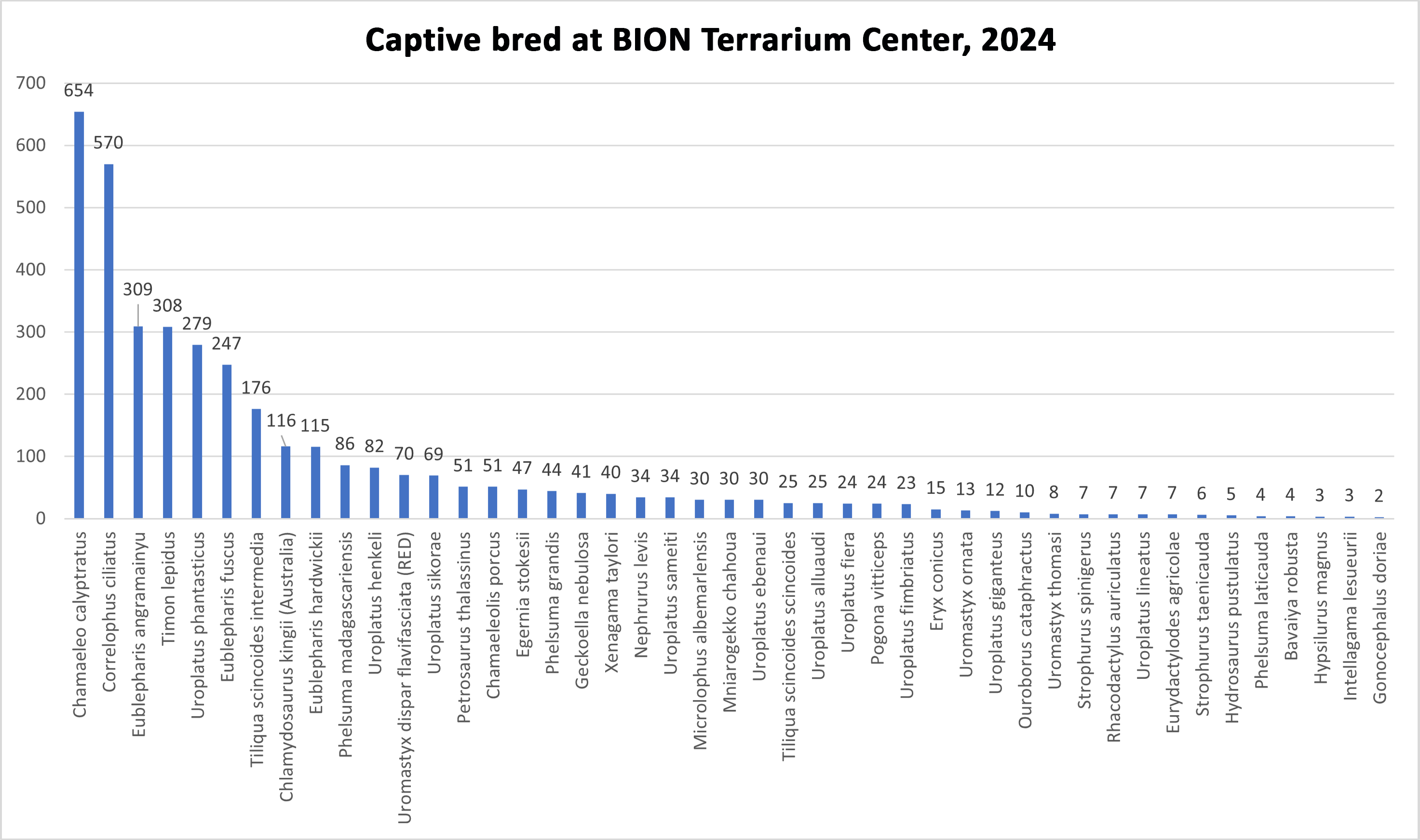
The breeding of reptiles is still BTC’s main specialty. During the specified period (2022–2024), more than 100000 specimens were bred at the BTC. This was largely due to the use of Serhiy Prokopiev's breeding stock, which was evacuated from his destroyed house in the Kharkiv area and placed in BTC for temporary keeping.
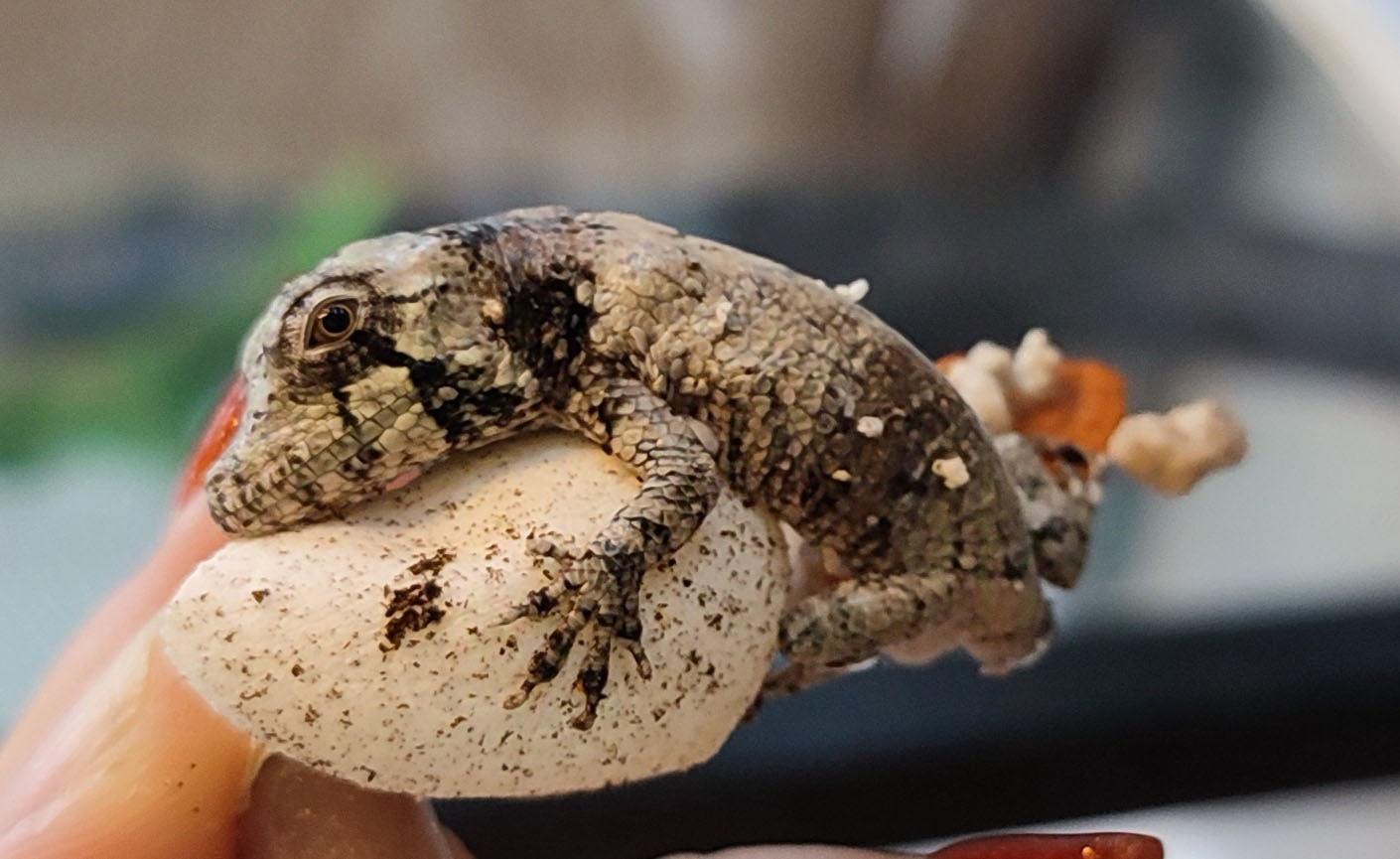
In 2024 we bred around 300 satanic leaf tailed geckos only, which, taking into account that at the beginning of 2022 during the first weeks of the war we lost about 30% of the breeding stock, can be considered an excellent result.
All animals undergo a complete technological process of breeding - from raising captive bred juveniles to making breeding pairs/groups of adult sexually mature animals. The breeding process is always recorded in the form of statistics, photo and video reports. The origin of breeding stock is well documented and meets all CITES requirements. We do our best to make our activity transparent.
BTC regularly shares its annual reptile breeding successes from its laboratory complexes with a wide audience on social media (Facebook page with more than 15 500 followers).
For a long time, the BTC actively published the reports of its professional activities (husbandry and breeding care sheets and results and breeding reports) as well as scientific articles released in international peer-reviewed publications, including ones from the Scopus lists; the materials and abstracts of Ukrainian and International conferences.
In this year we got cb Timon kurdistanikus from Czech Republic, Hosmer’s skinks from Germany and assorted tree monitors species from Indonesia for BTC breeding projects. We continue our work with Parson’s chameleons as well
Information on BION breeding for 2024 can be found in the histogram.
2025
Animal’s husbandry and breeding in BION is always a question of improvement.
This year we are trying our best to provide new facilities for tree monitors, parsons chamaeleons,
Leaf tailed geckos, Upgrade rooms for frilled lizards and blue rock iguanas.
Also we are planning to keep large species like Cyclura, Varanus, etc in the new outdoor enclosures all warm part of the year.
Within 2022–2025 BTC’s main achievements were survival + development + trust that peace will come. Even during martial time, we managed to discover important advantages. We strengthened and rallied our team, spending a lot of time adopting and breeding to emergency conditions, to improve our approaches and to start new optimistic and ambitious breeding projects. We continue with enthusiasm our Responsible Herpetoculture project aimed at creating and managing stable ex situ populations of amphibians and reptiles by private breeders, zoos and pro reptile keeping organizations worldwide.
On April 15, 2024 we already released 20(twenty) RH Journal issues (both in digital and printed versions).
For today it is the only periodical on Herpetoculture and Herpetology managed by Editors from Australia, China, Europe, Latin America and USA https://responsibleherpetoculture.foundation/category/rh-journal/
We also count on your support on BION Patreon!
Information on BION breeding for 2024 should be presented at the end of this year.