






BION BREEDING CENTER OF BION

BREEDING CENTER OF BION
BION Breeding Center: doing our best to ensure healthy reptile’s surplus
BION Breeding Center
Main idea of BTC breeding center is to bring and establish certain rare and hard to breed species in reserve populations, make our contribution to development of ex situ conservation, create new and update already existing husbandry approaches . BTC is developing the technical, resource, and personnel capabilities necessary to establish reserve populations of rare and valuable species.


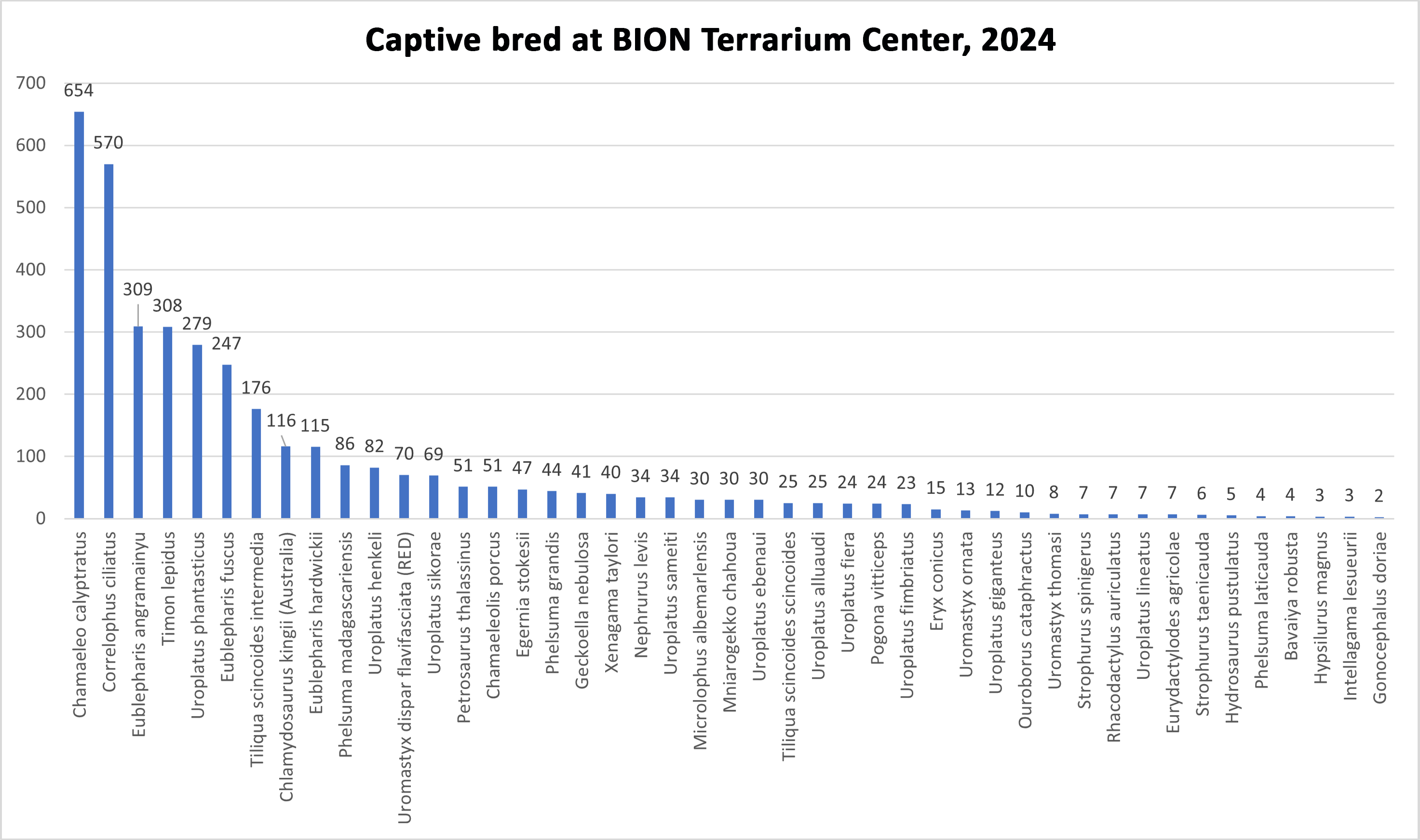
So far, 120 species of amphibians and reptiles have been bred at BTC across 32 years. We have developed techniques for ex situ breeding of many species in artificial conditions.
All animals undergo a complete technological process of breeding - from raising captive bred juveniles to making breeding pairs/groups of adult sexually mature animals. The breeding process is always recorded in the form of statistics, photo and video reports. The origin of breeding stock is well documented and meets all CITES requirements. We do our best to make our activity transparent. For a long time, the BTC actively published the reports of its professional activities (husbandry and breeding care sheets and results and breeding reports) as well as scientific articles released in international peer-reviewed publications, including ones from the Scopus lists; the materials and abstracts of herpetological conferences.
One might think that it is just another business. Well, our business part is just the way of self-sustainability, as we don’t have any patrons and we have to earn our life on our own. It helps us to maintain our collection, continue our work, meet the needs of the global market (therefore making illegal trade and poaching senseless) which results in wild populations remaining safe and are no longer of interest to mass poachers. But the danger of total destruction or change of suitable habitats always remains. In these terms, our work provides gene pool of healthy captive bred animals and methods of work with them, that might be useful for rewilding projects or for support of remaining wild populations. Thus, an idea of Conservation through Commercialization seems to be workable!
Through collaborations with reputable organizations like the German Association of Terrariumists and Herpetologists (DGHT), the Responsible Reptile Keeping organization from the Great Btitain (RRK), the Herpetofauna Foundation, The Netherlands and others, - BTC promotes Herpetoculture as a powerful tool for ex situ conservation. BTC long-term breeding results and statistics provide a serious base for international expertise and scientific conclusions to oppose the activity of animal rights campaigners.
We are always open for collaboration with reliable private breeders, zoos and other Reptile positive oriented institutions!
For many years we are working with breeders and dealers from all over the world to get animals with different gene pools. A lot of species are bred in several generations.
We pay special attention to their health and well-being and gladly share our knowledge with all interested parties. New species are added every year and new breeding projects are started on a regular basis. Pls follow us on BION webpage, FB, Instagram and Patreon!
LOOKING FORWARD TO HEAR FROM A NEW TRADE PARTNERS !
BION team
BION is a friendly and professional team. Today, we have 30 staff members engaged in the care and breeding of reptiles. Part of them has degrees in biology and everyone is highly experienced and full of enthusiasm and great love for animals. 3 people are involved in research and 3 – in marketing and sales, 2 persons working in logistic and 3 in administration.
BION facilities
Currently we utilize 20 laboratories, a greenhouse for large species, quarantine area, and laboratories for breeding various insects to ensure a healthy diet for our animals. The total area of our facilities exceeds 2000 m2. This enables us to keep simultaneously about 70 reptile species in quantities. Thus, we can comply with the requests for popular and rare reptiles’ species


To produce quality surplus we tried our best to create optimal for reptile husbandry and reproduction conditions:
- facilities and cages suited for individual species needs;
• poper temperature, lighting, humidity;
• clean and healthy enclosures; - balanced nutrition.
Therefore, taking animals from BION, you can be sure you get healthy reptiles.
You are always welcome to visit our center to make sure all reptiles are kept in adequate conditions and/or to get more knowledge about their husbandry.
BION speciality
As it was indicated before, from 1993 to the present time, we have bred 121 species of amphibians and reptiles.
The following groups of reptiles are being kept & bred at the BION Breeding Center for today:
- Chameleons
- Cuban false chameleons
- Leaf-tailed geckos (keeping one of the largest found stock of 7 Uroplatus spp at the world)
- Terrestrial geckos
- Agamas
- Agamas (including Spiny-tailed lizards)
- Iguanas (including Rhino iguanas)
- Jewelled lizards (Ocellated lizards)
- Philippine Sailfin dragons
- Skinks (Tiliqua and Egernia species)
- Armadillo lizard (few breeding groups)
- Monitors
- Tortoises
- And much more
BRED AT BION SINCE 1993:
| Latin Name | Common Name |
| Chamaeleonidae | |
| Calumma parsonii | Parson's chameleon |
| Chamaeleo calyptratus | Veiled chameleon |
| Furcifer pardalis | Panther chameleon |
| Furcifer lateralis | Carpet chameleon |
| Furcifer balteatus | Two-banded chameleon |
| Trioceros jacksonii xantholophus | Jackson’s chameleon |
| Trioceros jacksonii merumontanus | Meru Jackson's chameleon |
| Trioceros hoehnelii | Höhnel's chameleon |
| Trioceros melleri | Meller's chameleon |
| Trioceros montium | Cameroon sailfin chameleon |
| Trioceros quadricornis | Four-horned chameleon |
| Trioceros deremensis | Usambara three-horned chameleon |
| Bradypodion fischeri | Fischer's chameleon |
| Gekkonidae | |
| Uroplatus giganteus | Giant leaf-tail gecko |
| Uroplatus henkeli | Henkel's flat-tailed gecko |
| Uroplatus phantasticus | Satanic leaf-tailed gecko |
| Uroplatus lineatus | Lined flat-tail gecko |
| Uroplatus pietschmanni | Cork-bark leaf-tail gecko |
| Uroplatus ebenaui | Spearpoint leaf-tailed gecko |
| Uroplatus fimbriatus | Common flat-tailed gecko |
| Uroplatus guentheri | Günther's flat-tailed gecko |
| Uroplatus alluaudi | Northern leaf-tailed gecko |
| Uroplatus sikorae | Mossy leaf-tailed gecko |
| Uroplatus sameiti | Southern leaf-tailed gecko |
| Paroedura picta | Panther gecko |
| Hemidactylus imbricatus | Carrot-tail viper gecko |
| Phelsuma madagascariensis | Madagascar day gecko |
| Phelsuma lineata | Lined day gecko |
| Phelsuma laticauda | Gold dust day gecko |
| Phelsuma grandis | Madagascar giant day gecko |
| Phelsuma quadriocellata | Peacock day gecko |
| Gekko gecko | Tokay gecko |
| Eublepharidae | |
| Eublepharis macularius | Common leopard gecko |
| Eublepharis hardwickii | East Indian leopard gecko |
| Eublepharis fuscus | West Indian leopard gecko |
| Eublepharis angramainyu | Iranian eyelid gecko |
| Hemitheconyx taylori | Taylor's fat-tailed gecko |
| Hemitheconyx caudicinctus | African fat-tailed gecko |
| Diplodactylidae | |
| Oedura monilis | Ocellated velvet gecko |
| Oedura castelnaui | Northern velvet gecko |
| Eurydactylodes agricolae | Bauer's chameleon gecko |
| Mniarogekko chahoua | Short-snouted New Caledonian gecko |
| Correlophus ciliatus | Crested gecko |
| Rhacodactylus auriculatus | Gargoyle gecko |
| Carphodactylidae | |
| Nephrurus levis | Three-lined knob-tailed gecko |
| Nephrurus amyae | Centralian rough knob-tailed gecko |
| Nephrurus cinctus | Northern banded knob-tailed gecko |
| Underwoodisaurus milii | Thick-tailed gecko |
| Sphaerodactylidae | |
| Teratoscincus scincus | Common wonder gecko |
| Teratoscincus keyzerlingii | Giant frog-eyed gecko |
| Agamidae | |
| Uromastyx ornata ornata | Ornate spiny-tailed lizard |
| Uromastyx ornata philbyi | Saudi Arabian spiny-tailed lizard |
| Uromastyx dispar flavifasciata | Red-banded spiny-tailed lizard |
| Uromastyx thomasi | Omani spiny-tailed lizard |
| Saara hardwickii | Hardwicke's spiny-tailed lizard |
| Xenagama taylori | Dwarf shield-tailed agama |
| Xenagama batilifera | Beaver-tailed agama |
| Pogona barbata | Eastern bearded dragon |
| Pogona vitticeps | Central bearded dragon |
| Pogona henrylawsoni | Pygmy bearded dragon |
| Chlamydosaurus kingii | Australian frilled lizard |
| Hypsilurus magnus | Angle-headed forest dragon |
| Hydrosaurus pustulatus | Philippine sailfin lizard |
| Phrynocephalus guttatus alpherakii | Spotted toad-headed agama |
| Phrynocephalus mystaceus | Secret toad-headed agama |
| Phrynocephalus helioscopus | Sunwatcher toadhead agama |
| Gonocephalus chamaeleontinus | Chameleon forest dragon |
| Agama sinaitica | Sinai agama |
| Physignathus cocincinus | Chinese water dragon |
| Iguanidae | |
| Ctenosaura pectinata | Mexican spiny-tailed iguana |
| Tropiduridae | |
| Microlophus albemarlensis | Galapagos lava lizard |
| Phrynosomatidae | |
| Phrynosoma asio | Giant horned lizard |
| Sceloporus minor | Red minor lizard |
| Petrosaurus thalassinus | Baja blue rock lizard |
| Scincidae | |
| Tiliqua scincoides intermedia | Northern blue-tongued skink |
| Tiliqua scincoides scincoides | Eastern blue-tongued skink |
| Tiliqua gigas | Indonesian blue-tongued skink |
| Cunningham's skink | Cunningham's spiny-tailed skink |
| Egernia stokesii | Gidgee skink |
| Corytophanidae | |
| Basiliscus vittatus | Brown basilisk |
| Basiliscus plumifrons | Plumed basilisk |
| Anguidae | |
| Abronia taeniata | Banded arboreal alligator lizard |
| Lacertidae | |
| Timon lepidus | Jewelled lizard |
| Varanidae | |
| Varanus cumingi | Yellow-headed water monitor |
| Varanus acanthurus | Australian spiny-tailed monitor |
| Cordylidae | |
| Ouroborus cataphractus | Armadillo girdled lizard |
| Dactyloidae | |
| Chamaeleolis porcus | Cuban false chameleon |
| Anolis baracoae | Baracoa anole |
| Testudinidae | |
| Testudo horsfieldii | Central Asian tortoise |
| Testudo graeca | Greek tortoise |
| Geochelone pardalis | Leopard tortoise |
| Geochelone elegans | Indian star tortoise |
| Emydidae | |
| Emys orbicularis | European pond turtle |
| Boidae | |
| Eryx conicus | Common sand boa |
| Eryx tataricus | Tartar sand boa |
| Eryx miliaris nogaiorum | Dwarf sand boa |
| Boa constrictor | Common boa |
| Tropidophis melanurus | Wood snake |
| Pythonidae | |
| Morelia spilota cheynei | Jungle carpet python |
| Morelia spilota metcalfei | Murray Darling carpet python |
| Morelia viridis | Green tree python |
| Colubridae | |
| Rhabdophis tigrinus | Tiger keelback (red & blue morphs) |
| Elaphe schrenckii | Amur ratsnake |
| Elaphe climacophora | Japanese ratsnake |
| Zamenis situla | Leopard snake |
| Elaphe dione | Steppe ratsnake |
| Coelognathus radiatus | Radiated ratsnake |
| Euprepiophis mandarinus | Mandarin ratsnake |
| Oreocryptophis porphyraceus | Thai bamboo ratsnake |
| Lampropeltis triangulum campbelli | Pueblan milk snake |
| Lampropeltis triangulum sinaloae | Sinaloan milk snake |
| Lampropeltis triangulum hondurensis | Honduran milk snake |
| Lampropeltis calligaster | Yellow-bellied kingsnake |
| Pantherophis guttatus | Corn snake |
| Dendrobatidae | |
| Dendrobates tinctorius | Dyeing poison dart frog |
| Rhacophoridae | |
| Theloderma corticale | Vietnamese mossy frog |
| Theloderma bicolor | Chapa bug-eyed frog |
| Mantellidae | |
| Mantella aurantiaca | Golden mantella |
| Salamandridae | |
| Neurergus kaiseri | Kaiser's mountain newt |
| Salamandra salamandra giglioli | Italian fire salamander |
We are always happy to answer your questions and provide proper information about any reptile species we keep and breed .
In fact, we make money through sale of reptiles.
But it is also true that we invest our profit in RHF www.responsibleherpetoculture.foundation